


BUSINESS · CULTURE · FOOTBALL · FLORIDA
Nu Stadium, New World: How Brazil Is Claiming Miami — and Orlando
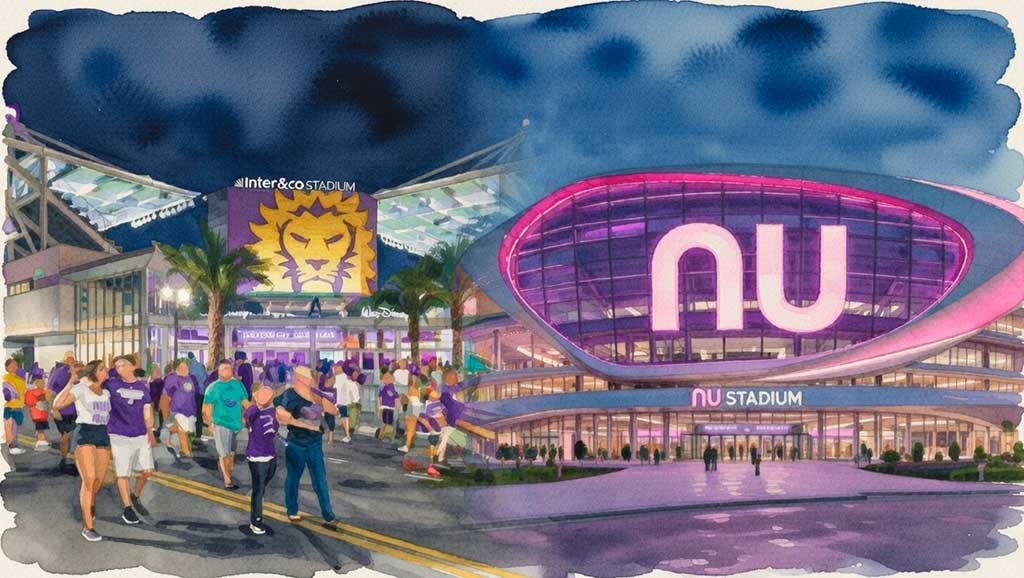
From Nubank’s landmark Nu Stadium in Miami to Banco Inter’s Inter&Co Stadium in Orlando, two Brazilian fintech giants are rewriting Florida’s sports and financial landscape — and the communities behind them are transforming two of America’s fastest-growing cities.
Miami & Orlando, Florida | March 2026
On the evening of March 3, 2026, the Miami skyline was painted in pink and purple. Drones traced a glowing heartbeat over Biscayne Bay, and the steel frame of a brand-new 26,700-seat stadium pulsed with light near Miami International Airport. It was a celebration — but also a declaration. Inter Miami CF had just announced that its new stadium would carry the name of Nubank, Latin America’s most powerful digital bank. Nu Stadium had arrived, and with it, a new chapter in the story of Brazil’s remarkable conquest of Florida.
Yet 230 miles north, in the heart of Downtown Orlando, another Brazilian financial giant had already made its move. In January 2024, Banco Inter’s holding company, Inter&Co, had quietly beaten Nubank to the punch — securing the first-ever stadium naming rights deal by a Latin American financial institution in the United States. Two Brazilian fintechs, two Florida cities, two soccer stadiums. The game is on.
THE MIAMI DEAL: NUBANK GOES BIG
Under its multi-year partnership, Nubank — operating as Nu in its international markets — acquires the naming rights to Inter Miami’s new home at Miami Freedom Park, the sprawling 131-acre entertainment district near Miami International Airport. The stadium, Nu Stadium, opens April 4, 2026, when Inter Miami faces Austin FC in its first home match.
The scope of the agreement extends well beyond the stadium’s name. Nu’s logo will appear on the back of Inter Miami’s jerseys starting in August 2026 — one of the best-selling jerseys in global football, powered by the presence of eight-time Ballon d’Or winner Lionel Messi. Inside the venue, Nubank anchors two signature experiences: the Nu Club, a 770-person premium hospitality lounge with a glass tunnel view of the pitch, and the Nu Plaza, a public-facing community hub.
“Nu Stadium will anchor our brand in the United States, allowing us to engage with a diverse, international community as we build the most influential consumer technology platform in the world.” — Cristina Junqueira, Co-Founder & CEO of Nu U.S.
For Nubank, the timing is deliberate. The company applied for a U.S. national bank charter with the Office of the Comptroller of the Currency in September 2025 and received conditional approval just 121 days later. Rather than launch with a traditional advertising campaign, Nubank chose to anchor its American identity to the most commercially powerful club in MLS — and to do it with a stadium bearing its name.
THE ORLANDO PIONEER: INTER&CO STADIUM
While Nubank gets the bigger headlines, it was Banco Inter that first planted Brazil’s financial flag on American soil. In January 2024, Inter&Co — the holding company that controls Banco Inter and all its international operations — announced a 10-year naming rights agreement with Orlando City SC and the Orlando Pride, renaming the club’s downtown home Inter&Co Stadium. The deal made Inter&Co the first Latin American financial institution to hold naming rights to a major U.S. stadium.
The partnership was more than a branding exercise. Inter&Co became the official sponsor for accounts, debit and credit cards, mortgages, and remittances for Orlando fans, integrating its Super App products directly into the fan experience. Stadium upgrades accompanied the deal: a new state-of-the-art video board, 250 new TVs throughout the venue, upgraded Wi-Fi 6 and 5G infrastructure, and a new hospitality section called The Terrace.
The venue — originally Orlando City Stadium (2017), then Exploria Stadium (2019) — was designed by the renowned architecture firm Populous and privately funded by its original owner, Brazilian entrepreneur Flávio Augusto da Silva, at a cost of $155 million.
João Vitor Menin, CEO of Inter&Co, put it plainly: the Orlando partnership was about more than sponsorship — it was about connecting with the Brazilian diaspora living and working across Florida’s I-4 corridor, and establishing Inter as their financial home in the United States.
HEAD TO HEAD: NUBANK VS. BANCO INTER
These two companies are Brazil’s most celebrated digital banking rivals — different in scale and strategy, but united by their ambition to conquer the United States. Here is how they compare:
| METRIC | NUBANK (Nu) | BANCO INTER (Inter&Co) |
| Founded | 2013, São Paulo | 1994 → Digital 2016, Belo Horizonte |
| Customers (2025) | 120M+ | 38M+ |
| Markets | Brazil, Mexico, Colombia | Brazil + U.S. expansion |
| Q1 2025 Revenue | $3.25B (annualized ~$13B) | $0.5B annual |
| Q1 2025 Net Income | $557M | ~$52M |
| U.S. Strategy | Nu Stadium (Miami) + bank charter | Inter&Co Stadium (Orlando) + Super App |
| Florida Stadium | Nu Stadium — Miami Freedom Park | Inter&Co Stadium — Downtown Orlando |
| Stadium Deal | 2026, multi-year naming rights | 2024, 10-year naming rights |
| Jersey Sponsor | Inter Miami CF (from Aug 2026) | Orlando City SC (Official Partner) |
| Market Cap | ~$60B+ | ~$15B |
| Efficiency Ratio | 24.7% (world-class) | 48.8% |
The scale difference is significant. Nubank is in a different commercial universe — with 120 million customers across three countries, a quarterly revenue of $3.25 billion, and a market cap exceeding $60 billion, it is the world’s most profitable neobank and the largest digital bank outside Asia. Inter&Co, with 38 million customers and revenues roughly one-tenth of Nubank’s, is a formidable but distinctly smaller player.
Yet in the U.S. market, both are newcomers fighting for the same prize: the loyalty and financial lives of millions of Brazilians who have made Florida their home. And in that context, Inter&Co was first. It identified the opportunity in Orlando’s Brazilian community years before Nubank made its Miami move, and it built institutional relationships, financial literacy programs, and fan experiences designed to serve that community from the ground up.
Two Brazilian fintechs. Two Florida cities. The same prize: the financial lives of America’s fastest-growing immigrant community.
The rivalry mirrors their broader competitive dynamic in Brazil itself. Nubank dominates on brand recognition, customer engagement (83% monthly active rate vs. Inter’s 57%), and operational efficiency. Inter&Co competes on breadth — offering cross-border accounts, a marketplace, insurance, and a more comprehensive suite for business customers and expats. In the U.S., that cross-border strength is arguably Inter’s sharpest edge.
INTER MIAMI: A BRAZILIAN VENTURE AT HEART
It is no coincidence that Brazilian capital feels so at home at Inter Miami. The club carries deep Brazilian DNA — not only in its fan base, but in its ownership philosophy and identity. The Mas brothers, Jorge and Jose, alongside co-owner David Beckham, built a club deliberately designed to serve as a bridge between North America and Latin America.
Inter Miami’s name — “Club Internacional de Fútbol Miami” — speaks to its global aspirations. The club secured four major titles in just six seasons, including the 2025 MLS Cup. When Messi arrived in 2023, he transformed the club’s commercial value from roughly $585 million to an estimated $1.2 billion — making it MLS’s most valuable franchise. Its jerseys are among the best-selling in world football.
The Nubank partnership deepens this Brazilian-Miami axis. Cristina Junqueira, Nubank’s co-founder and CEO of its U.S. business, has already relocated to Miami — underscoring the company’s commitment to making South Florida its American headquarters. Miami is becoming, in every real sense, the American capital of Brazilian enterprise.
MIAMI’S BRAZILIAN COMMUNITY: BY THE NUMBERS
| MIAMI — GREATER MIAMI-DADE AREA: BRAZILIAN COMMUNITY | |
| Estimated Brazilian residents (Greater Miami) | 450,000 |
| Share of all U.S. Brazilian immigrants in SE Florida | ~25% (Broward, Miami-Dade, Palm Beach) |
| Brazilian investments in Florida (2022) | $1.5B+ (↑30% vs. pre-pandemic) |
| Brazil–Miami commercial exchange (2023) | ~$8B |
| Brazilian share of luxury real estate purchases | ~20% of transactions |
| Brazilians estimated to own property in Miami | 15,000+ |
| Key neighborhoods | Brickell, Doral, Aventura, Sunny Isles |
| Primary drivers of migration | Political uncertainty, BRL devaluation, tax advantages, cultural fit |
This is not a quiet migration. Brazilian entrepreneurs, tech founders, investors, and professionals have reshaped neighborhoods from Brickell to Doral, built Portuguese-language business networks, and established cultural institutions that make Miami feel, in many respects, like Brazil’s largest northern city. They come seeking stability and opportunity — and increasingly, they stay to build empires.
ORLANDO’S BRAZILIAN COMMUNITY: FLORIDA’S HIDDEN ENGINE
While Miami grabs the headlines, Orlando’s Brazilian story is just as compelling. The city of 334,000 people sits at the center of a metro area approaching 2.2 million — and Brazilians are one of its most visible and economically active communities.
| ORLANDO — ORANGE COUNTY AREA: BRAZILIAN COMMUNITY | |
| Brazilian ancestry share of Orlando city population | ~3.4% (among top 3 ancestries listed) |
| Estimated Brazilian residents, Orlando city | ~150,000 |
| Top Florida cities for Brazilian population | #1 Deerfield, #2 Orlando, #3 Pompano Beach |
| Orlando metro total population (2025) | ~2.13 million (↑1.33% YoY) |
| Visible Brazilian presence | International Drive, OIA (Portuguese signage), Kissimmee corridor |
| Key attractions for Brazilians | Theme parks, hospitality sector, lower cost of living vs. Miami |
| Brazilian cultural footprint | Restaurants, supermarkets, real estate agencies, travel businesses |
Brazilians have been part of Orlando’s fabric for decades — drawn first by tourism (Orlando is one of the most visited destinations for Brazilian travelers), then by the hospitality and service economy, and increasingly by entrepreneurship and real estate investment. Portuguese-language signage at Orlando International Airport reflects the community’s scale and economic importance to the city’s tourism industry.
The I-4 corridor — stretching from Orlando through Kissimmee and Lakeland toward Tampa — has one of the densest concentrations of Brazilian-owned small businesses in the United States. It is no accident that Inter&Co chose Orlando, not just as a branding vehicle, but as the beachhead for its American financial services expansion. The community was already there, underserved by U.S. banks and deeply familiar with Banco Inter from their lives in Brazil.
FLORIDA AS BRAZILIAN TERRITORY: A STATE TRANSFORMED
Taken together, the Brazilian communities of Miami and Orlando represent something historic: the emergence of a geographically distributed, economically powerful diaspora that is remaking one of America’s most dynamic states from the inside out.
Florida hosts an estimated 113,915 Brazilian residents according to Census ACS data — but this is widely understood to be a significant undercount, as many Brazilians hold visas, dual citizenship, or have not participated in census enumeration. Real estimates put the figure at 600,000, with Greater Miami and the I-4 corridor together accounting for the vast majority.
What is undeniable is the footprint. Two of Brazil’s most innovative fintech companies have now named two of Florida’s most prominent soccer stadiums. The state’s commercial real estate, hospitality, and professional services sectors are deeply woven with Brazilian capital and talent. And with Nubank seeking a federal banking charter and Inter&Co operating its Super App for the Brazilian diaspora, the financial infrastructure for a permanent, self-sustaining Brazilian economy within Florida is being built in real time.
From Brickell to International Drive, Brazilians are not just living in Florida — they are building the infrastructure of a parallel economy that is quietly becoming one of the state’s most powerful growth engines.
THE BIGGER PICTURE: CAPITAL WITHOUT BORDERS
The Nubank and Inter&Co stadium deals sit at the intersection of several forces that have been reshaping both cities’ identities. Miami has long positioned itself as the financial gateway to Latin America — a place where capital flows freely between continents, where Spanish and Portuguese are languages of commerce, and where geography makes it uniquely suited to serve as a hub for the Americas. Orlando has positioned itself as the theme park capital of the world — but it is increasingly also a business hub, with a growing tech and fintech ecosystem fed by its diverse international community.
What is newer, and more striking, is the direction of that capital flow. For decades, Florida attracted Latin American money seeking safety and stability. Now, increasingly, it is attracting Latin American ambition — companies and entrepreneurs not just parking wealth here, but building their global futures here.
Nubank, with 120 million customers and a $60 billion market cap, is the clearest example of this shift. Inter&Co, with its cross-border financial tools purpose-built for the Brazilian diaspora, is the quieter but perhaps more strategically precise one. Together, they are making a statement that the Brazilian fintech industry — once dismissed as a regional phenomenon — is now a genuine force in the global financial system.
NU STADIUM: MORE THAN A NAME
When Inter Miami plays its first home game at Nu Stadium on April 4, 2026, the stadium will be more than a football venue. It will be a symbol — of what Brazilian innovation looks like when it meets American scale, of what happens when a community that once arrived seeking opportunity begins to define the city it adopted.
The 131-acre Miami Freedom Park surrounding the stadium will feature over a million square feet of retail, dining, entertainment, and office space, a 58-acre public park, 750 hotel rooms, and a year-round entertainment district. At its center, Nu Stadium — bathed in Inter Miami’s pink and Nubank’s vivid purple — will stand as a monument to what two countries can build when they decide to dream together.
And 230 miles north, at a stadium that wears the name of a bank born in Belo Horizonte, Orlando City will play on — in front of a crowd that includes thousands of Brazilians who know exactly what that name means, and what it cost to put it there.
Nu Stadium at Miami Freedom Park opens April 4, 2026. Inter Miami CF vs. Austin FC. Kickoff: 7:30 PM ET. Inter&Co Stadium, Downtow
