

For generations, baseball has been synonymous with American sports culture. Today, however, a clear shift is underway. Soccer is rapidly becoming one of the most compelling, culturally influential, and economically impactful sports in the United States. Stadium attendance, television viewership, and fan engagement—especially among younger and multicultural audiences—demonstrate that soccer is no longer a niche interest. It is actively shaping the future of the American sports landscape.
With the FIFA World Cup 2026 fast approaching, this transformation is accelerating. The United States will host the world, and cities such as Boston are already preparing for the scale of cultural energy and economic activity the tournament will bring.
Road to 2026: An Official International Soccer Event
Road to 2026 is an official international soccer event series created to build momentum toward the FIFA World Cup 2026. The initiative brings elite national teams to U.S. stadiums, offering fans World Cup–level competition years in advance while activating host cities through tourism, media exposure, and community engagement.
These matches are not casual exhibitions. They are strategic international friendlies tied directly to World Cup preparation, global visibility, and diaspora participation—particularly among Brazilian, Colombian, French, and Croatian communities, whose supporters consistently fill stadiums across the country.
Exclusive Road to 2026 International Matches – March 2026
As part of the Road to 2026 event, Nossa Radio USA has been granted exclusive Portuguese-language broadcasting rights for the following international matches scheduled for March 2026:
Brazil vs. France
Colombia vs. Croatia
Colombia vs. France
Brazil vs. Croatia
These fixtures are expected to draw strong attendance and viewership, particularly from Brazilian fans, who are known for traveling in large numbers, creating high-energy stadium environments, and contributing significantly to local economies.
Boston, the World Cup, and a $600 Million Economic Impact
Boston is positioned to be one of the major U.S. beneficiaries of the 2026 World Cup.
Seven World Cup matches are planned for the Boston region
An estimated $600 million in total economic impact is projected
Spending is expected across hotels, restaurants, transportation, retail, tourism, and entertainment
Brazilian supporters are expected to play a visible role in this impact. Historically, Brazilian fans stay longer, spend more, and actively participate in cultural events surrounding matches. Their presence enhances not only revenue but also the global profile of host cities.
For Boston, the World Cup represents both a financial opportunity and a moment to showcase its multicultural identity on an international stage.
New England Sports Recognize the Brazilian Community
This growing awareness of Brazilian influence is already evident across New England’s major sports organizations:
The Boston Red Sox recently hosted a Brazilian Night, acknowledging the size and importance of the Brazilian community in Greater Boston.
The New England Revolution have traditionally held an annual Brazilian Night at Gillette Stadium, reinforcing the deep connection between soccer and Brazilian culture.
The Boston Celtics have scheduled a Brazilian-focused event on February 6, signaling that this audience matters far beyond the soccer pitch.
These initiatives are strategic, not symbolic. Brazilian fans are loyal, highly engaged, and influential in shaping ticket demand, in-venue atmosphere, and long-term brand relevance.
Beyond Soccer: Brazilians and PBR at TD Garden
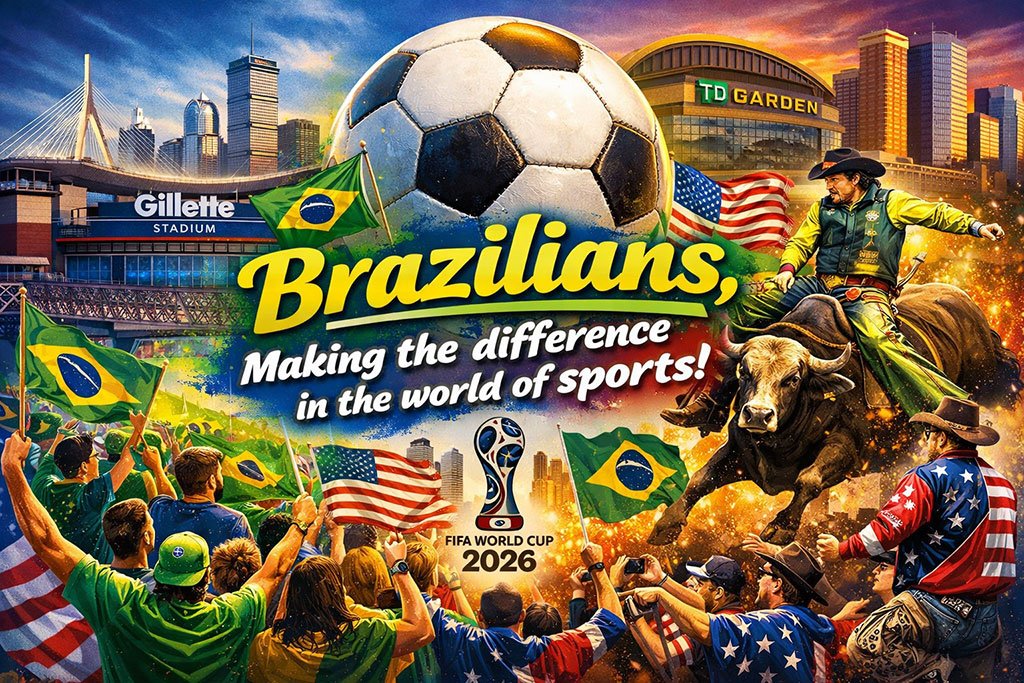
The influence of Brazilian fans extends well beyond soccer. Recently, TD Garden was filled with Brazilian supporters for a Professional Bull Riders (PBR) event—another clear demonstration of the community’s reach and buying power.
Brazilian athletes are among the most dominant competitors in PBR, and their fans consistently follow them nationwide. This same pattern is evident in soccer: where Brazilian athletes compete, Brazilian audiences show up—consistently and at scale.
The NFL and Brazil: Patriots Expand Their Global Reach
Soccer is not the only sport recognizing Brazil’s strategic importance. In Foxborough, Massachusetts, the New England Patriots were recently awarded Brazil as their newest global territory as part of the NFL’s Global Markets Program (GMP).
Through this designation, the Patriots are now authorized to pursue in-person and digital marketing, corporate sponsorships, fan events, brand activations, merchandise sales, and co-marketing relationships with sports and entertainment properties in Brazil.
The Patriots have participated in the NFL’s GMP initiative since its launch in 2022—initially with rights in Germany, later expanding to Austria and Switzerland. Most recently, the organization took part in an NFL international game in Frankfurt, underscoring its long-term commitment to global growth.
This move further validates what soccer has already proven: Brazil is not just a fan base—it is a strategic sports market with global influence.
Soccer vs. Baseball: A Cultural Turning Point
Baseball remains an essential part of American sports history, but soccer is capturing the present and shaping the future. Its momentum is driven by:
Younger and more diverse fan bases
Strong connections to immigrant and second-generation communities
Global relevance amplified by events like the World Cup
High engagement across live events, digital platforms, and social media
For many fans—especially Brazilians and other international communities—soccer is more than entertainment. It is identity, heritage, and shared experience.
Looking Ahead
As the United States moves closer to hosting the world in 2026, soccer’s rise is no longer theoretical. It is visible in packed stadiums, measurable in economic projections, and reflected in how major sports organizations engage multicultural audiences.
Boston’s projected $600 million World Cup impact, the scheduling of seven matches, the Patriots’ expansion into Brazil, and the growing presence of Brazilian fans across soccer, basketball, baseball, and even bull riding all point to the same conclusion:
Soccer has become central to the American sports conversation—and Brazilian communities are playing a defining role in that transformation.


