





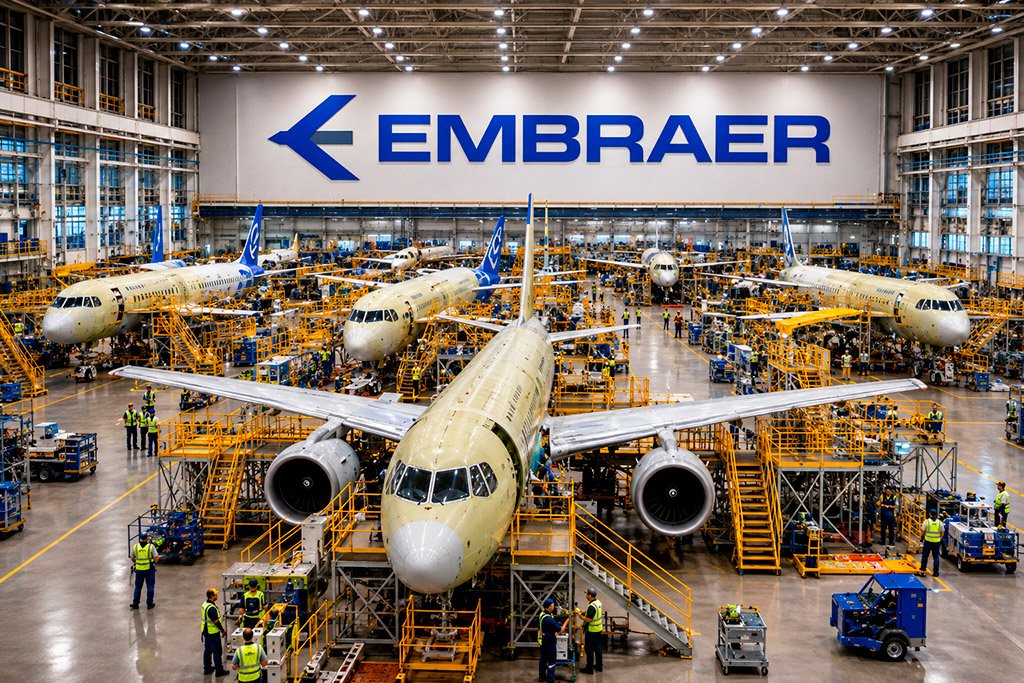
Embraer has completed the acquisition of the remaining 50% stake in EZ Air Interior Limited, an aircraft interior components manufacturer located in Chihuahua, Mexico, giving the Brazilian aerospace company full control of an operation considered strategic to the production of its E-Jets family.
The transaction was completed on July 1, 2026. EZ Air had operated as a joint venture between Embraer and C&D, now part of Safran Cabin, and was dedicated exclusively to programs involving Embraer aircraft.
Mexico Facility Employs Approximately 1,100 People
Located in one of Mexico’s most important aerospace manufacturing hubs, the Chihuahua facility employs approximately 1,100 people and produces key aircraft interior components for Embraer.
The plant manufactures items including overhead baggage compartments, galleys, lavatories and floor panels used in the company’s E-Jets family.
With full ownership of the operation, Embraer gains direct control over an even greater portion of the supply chain responsible for the interiors of its aircraft, increasing its ability to manage production, quality, delivery schedules and the development of components used across its programs.
Safran Cabin Operations in Jacareí Also Integrated Into Embraer
The transaction extends beyond Mexico.
As part of the agreement, Embraer also incorporated certain Safran Cabin operations located in Jacareí, São Paulo, Brazil, specifically activities dedicated to Embraer programs.
Safran Cabin engineering services in Brazil that serve other customers and are not connected to Embraer programs will remain under Safran’s control.
The transaction therefore creates stronger integration between operations in Brazil and Mexico, two countries that play important roles in Embraer’s international industrial network.
Chihuahua Is One of Mexico’s Leading Aerospace Hubs
The importance of the Chihuahua facility extends well beyond the factory itself.
The state has become one of Mexico’s most important aerospace industry clusters, attracting international manufacturers and suppliers specializing in machining, aircraft components and aerospace subassemblies.
According to data from the U.S. International Trade Administration, Mexico ranked among the world’s major aerospace manufacturing countries in 2024 and exported approximately US$10.7 billion in aerospace products.
Chihuahua is consistently identified as one of the country’s leading aerospace clusters.
The Chihuahua Aerospace Cluster reports that the region is home to more than 60 AS9100-certified aerospace operations, approximately 19,000 aerospace jobs and nearly US$2 billion in annual exports.
Embraer’s fully owned operation is therefore located within an established manufacturing ecosystem that is already deeply connected to international aerospace supply chains.
Acquisition Comes During a Period of Strong Growth for Embraer
The move also comes as Embraer experiences significant commercial expansion.
In July 2026, the company reported that its total firm order backlog had reached a record US$34.5 billion in the second quarter of 2026, representing an increase of approximately 16% compared with the same period a year earlier.
Commercial Aviation alone accounted for approximately US$15.1 billion of the company’s backlog.
Embraer also delivered 65 aircraft during the second quarter of 2026, its best second-quarter delivery performance in 16 years.
During the first half of the year, the company delivered 109 aircraft, approximately 20% more than the 91 aircraft delivered during the same period in 2025.
As aircraft orders increase and manufacturers seek to expand production, greater control over suppliers and key components can help Embraer create a more integrated and predictable industrial supply chain.
Mexicana de Aviación Ordered 20 Embraer E2 Aircraft
One of the agreements highlighting Mexico’s growing importance in Embraer’s commercial strategy is the aircraft order placed by state-owned airline Mexicana de Aviación.
In June 2024, Embraer announced a firm order for 20 E2 aircraft, divided equally between:
- 10 Embraer E190-E2 aircraft
- 10 Embraer E195-E2 aircraft
Mexicana configured the E190-E2 to carry 108 passengers, while the E195-E2 has a single-class configuration for 132 passengers.
The airline became the first carrier in Mexico to operate Embraer’s new-generation E2 aircraft.
Although Embraer did not publicly disclose the official value of the order in its original announcement, Mexican government documents and media reports have cited investments of approximately 20.8 billion Mexican pesos, equivalent at the time to around US$1.1 billion, related to the acquisition of the new aircraft.
Embraer Deliveries to Mexicana Are Expected to Continue Through 2027
The agreement has already moved beyond the order stage.
Mexicana began receiving its E195-E2 aircraft in 2025 and added E190-E2 aircraft to its fleet in 2026.
By June 2026, the airline had received its seventh Embraer aircraft under the program.
The complete fleet of 20 E2 aircraft is expected to be incorporated by the end of 2027.
The order gives Embraer not only an important customer in Mexico but also greater visibility in one of the largest aviation markets in the Americas.
Full Ownership of EZ Air Brings Embraer Closer to the North American Market
Taking full control of an industrial operation in Mexico also expands Embraer’s physical presence within the North American manufacturing and supply chain ecosystem.
Chihuahua offers geographic proximity to the United States as well as access to an established network of suppliers, logistics infrastructure and skilled aerospace workers.
Data from the U.S. Department of Commerce highlights the depth of this industrial relationship. In 2024, Mexico imported approximately US$6.3 billion in aerospace products from the United States.
The same government analysis identifies several Mexican suppliers connected to Embraer’s global supply chain.
In this environment, the Chihuahua operation can help reduce logistical distances while increasing supply chain flexibility for the Brazilian aircraft manufacturer.
What Role Does the USMCA Play?
Embraer’s industrial presence in Mexico also places the company inside a highly integrated regional economy shaped by the United States-Mexico-Canada Agreement, or USMCA.
However, manufacturing a product in Mexico does not automatically guarantee preferential tariff treatment under the agreement.
Eligibility depends on product classifications, rules of origin and other applicable trade requirements.
Civil aviation is also covered by separate international trade arrangements, including the World Trade Organization’s Agreement on Trade in Civil Aircraft, which eliminates tariffs on many civil aircraft, engines, parts and components among participating countries.
For this reason, the primary strategic advantage of Embraer’s presence in Mexico is not limited to tariffs.
Its importance also comes from regional supply chain integration, proximity to suppliers and customers, industrial infrastructure, logistics and access to a skilled aerospace workforce.
Embraer Strengthens Its Vertical Integration Strategy
By taking 100% ownership of EZ Air, Embraer no longer shares control of this manufacturing operation and can directly manage a facility responsible for important aircraft components.
When announcing the completion of the transaction, Francisco Gomes Neto, President and CEO of Embraer, said the company continues to evaluate opportunities capable of creating value while supporting the expansion of its operations in both the short and long term.
From an industrial perspective, the acquisition represents a move toward greater vertical integration.
Rather than depending entirely on a jointly controlled supplier structure, Embraer is bringing a strategically important part of its manufacturing chain closer to the company itself.
Greater control over component production can become particularly important at a time when aircraft manufacturers around the world continue to face challenges involving suppliers, component availability and the need to accelerate aircraft deliveries.
Brazil and Mexico Gain Importance in Embraer’s Global Expansion
The acquisition of EZ Air also demonstrates how the international expansion of one of Brazil’s most important technology companies is being built through an industrial network that crosses national borders.
From São José dos Campos and Jacareí in Brazil to Chihuahua in Mexico, Embraer’s manufacturing network is becoming increasingly connected to global aerospace markets.
For Brazilians and Portuguese-speaking communities living in the United States and New England, the company’s growth also provides an opportunity to follow the expansion of a major Brazilian technology and aerospace company within one of the world’s most important aviation markets.
With a record order backlog, increasing aircraft deliveries and new customers adopting the E2 family, full control of the Mexican facility represents another step in Embraer’s strategy to increase manufacturing capacity, strengthen its supply chain and support its continued expansion in the global aerospace industry.
JR DeOliveira
Portuguese Speakers
